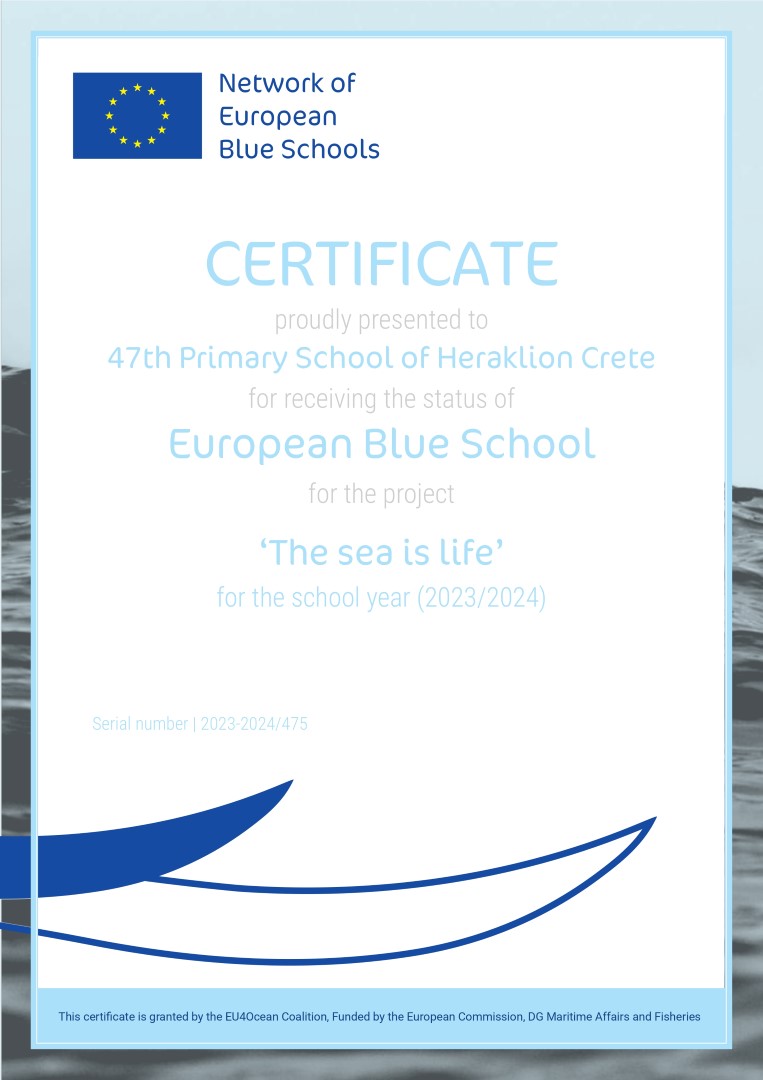
It's official! We are now officially a member of the network of European Blue Schools!
The approval of our application to join the network was a demanding process. It involves the implementation of a project with several activities, which must meet the criteria of the program.
Many congratulations to our students and teachers who contributed to this success!
#EU4Ocean
#EUBlueSchools
#OceanLiteracy
The network
A European Blue School brings the ocean into the classroom. It’s a school, which through project-based learning, engages students with marine- and maritime-related topics to create awareness and a feeling of responsibility for our ocean.
We live on a blue planet. We have one ocean, without which, life as we know would simply not exist.
The European Union, among its 27 Member States, has the largest maritime territory in the world (approximately 3.9 M km2) and a coastline of some 100,000 km. Over 16% of the population lives by the coast and the European Blue Economy directly generates close to 5 million jobs. Yet many European citizens are not aware of the importance of the ocean and the services it offers us – how it regulates the climate, how it produces much of the oxygen we breathe and the food we eat and supports human livelihoods and wellbeing.
The understanding of the ocean's influence on us - humans - and our influence on the ocean is known as Ocean Literacy.
The European Commission recognizes the urgent need to enhance the ocean literacy of European Citizens as a crucial element of the implementation of sustainable management of the ocean.
The EU4Ocean Coalition, with the support of DG MARE, brings together organizations, projects, and individuals committed to promoting ocean literacy across Europe. The Network of European Blue Schools is one of the three pillars of the Coalition, established as a hub for all schools and teachers that strive to engage students with oceanic topics and educate a new generation of ocean literate young citizens.
The concept of a European Blue School evolved from the marine education expertise gathered from consultations with teachers and educators across Europe. It acknowledges the variety of cultures and school communities from the 27 EU Member States and champions the concept of open schooling – encouraging the development of local partnerships to make the learning context relevant.